

Why Shop Limited Edition Art for Unique Style
Feb 05, 2026
Standing out in a world full of mass-produced style can feel nearly impossible when you crave something truly individual. Limited edition art offers a powerful answer, blending bold creativity with a carefully controlled sense of rarity that transforms each piece into a coveted collector’s item. Understanding how scarcity shapes value and identity reveals why these works matter so much for anyone seeking decor or fashion that tells a personal story and goes far beyond the ordinary.
Table of Contents
- Limited Edition Art Explained Clearly
- Types and Features of Limited Art Pieces
- How Scarcity and Exclusivity Drive Value
- Authenticity, Artist Signatures, and Proof
- Investment Benefits and Resale Potential
- Things to Watch: Pitfalls and Red Flags
Key Takeaways
| Point | Details |
|---|---|
| Understanding Limited Edition Art | Limited edition art consists of artworks produced in a predetermined number, enhancing their desirability and perceived value among collectors. |
| Importance of Authenticity | Key elements such as artist signatures and certificates of authenticity are essential for verifying the legitimacy and value of limited edition pieces. |
| Investment Potential | Limited edition art offers potential for long-term financial appreciation, making it a valuable addition to an investment portfolio. |
| Identifying Red Flags | Collectors should be cautious of missing documentation and unclear edition numbering, which may indicate potential fraud in the art market. |
Limited Edition Art Explained Clearly
Understanding limited edition art requires exploring the complex world where creativity meets exclusivity. In the art market, limited edition pieces represent a unique approach to collecting and appreciating visual expression, offering collectors something far beyond mass-produced artwork.
At its core, limited edition art means an artwork produced in a restricted, predetermined number of copies. Commodity theories of scarcity suggest that reducing availability dramatically increases an item’s perceived value and desirability. This strategic limitation transforms an artwork from a simple visual object into a coveted collector’s item.
Key characteristics of limited edition art include:
- Specific number of authorized reproductions
- Artist’s signature and unique numbering
- Documented commitment to not reproduce beyond the stated limit
- Certificates of authenticity verifying the artwork’s provenance
- Higher perceived value compared to unlimited prints
Authenticity and Exclusivity are the twin pillars that elevate limited edition art. Historical printmaking techniques established the foundation for this practice, where artists would create a master plate and restrict the number of impressions, ensuring each piece remains special.
Modern limited edition art has expanded beyond traditional mediums, encompassing digital art, photography, and mixed media. The core principle remains unchanged: creating a sense of rarity that transforms an artwork into a treasured, investment-worthy piece.
Here’s a comparison of traditional and modern limited edition art formats:
| Format Type | Mediums Included | Typical Authentication | Investment Appeal |
|---|---|---|---|
| Traditional | Etchings, lithographs, woodcuts | Signed, numbered print, COA | High among classic art collectors |
| Modern | Digital art, photography, mixed | Encrypted digital codes, COA | Growing in tech-savvy markets |
Pro Tip: Always verify the total edition size and your specific print number when purchasing limited edition art to understand its true collectible potential.
Types and Features of Limited Art Pieces
Limited edition art represents a diverse and fascinating world of creative expression, spanning multiple mediums and artistic techniques. Print editions encompass remarkable variety, ranging from traditional fine art prints to contemporary digital reproductions that challenge conventional artistic boundaries.
The primary types of limited edition art include:
- Prints: Etchings, lithographs, screenprints, and woodcuts
- Sculptures: Cast metal, ceramic, and mixed media works
- Photographic Art: Fine art photographs with restricted reproduction
- Digital Art: Numbered and authenticated digital creations
- Mixed Media: Combinations of traditional and modern artistic techniques
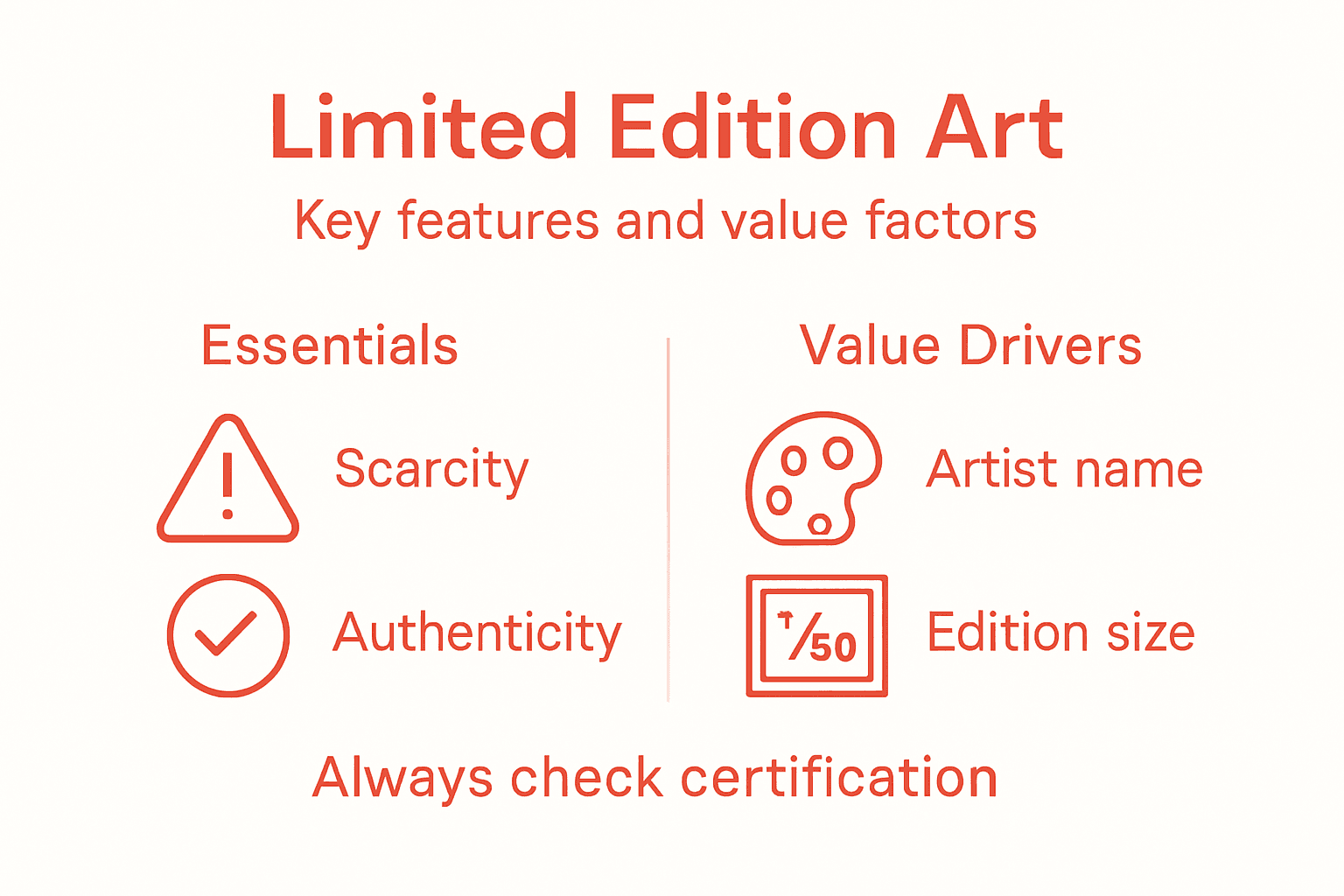
Numbering and Authentication play crucial roles in establishing an artwork’s legitimacy and value. Printmaking techniques create complex authentication systems where each piece receives a unique identifier, typically displayed as a fraction like 12/100, indicating its specific position within the total edition.
Beyond mere reproduction, limited edition art represents a bridge between artistic vision and collector’s appreciation. Each piece tells a story of craftsmanship, creativity, and intentional scarcity, transforming visual art into a highly personalized and investable experience.
Pro Tip: Always request and verify the certificate of authenticity when purchasing limited edition art to ensure its provenance and true collectible status.
How Scarcity and Exclusivity Drive Value
The psychological mechanism behind limited edition art’s allure is rooted in the fundamental principle of scarcity economics. Consumer desire intensifies through strategic supply limitation, creating a powerful dynamic where rarity transforms an artwork from a simple visual object into a coveted collector’s treasure.
Key psychological drivers of limited edition value include:
- Perceived uniqueness of the artwork
- Social status associated with ownership
- Investment potential
- Emotional connection to rare objects
- Sense of individual distinction
Exclusivity Mechanisms play a crucial role in elevating an artwork’s perceived worth. Psychological triggers of consumer desire are activated when potential collectors recognize that an artwork exists in a strictly controlled quantity, making each piece feel more significant and personally meaningful.
This scarcity principle operates beyond mere economics. It taps into deep human motivations of belonging, differentiation, and personal identity. When an artwork is produced in limited numbers, it becomes more than a visual experience—it transforms into a statement of individual taste, cultural awareness, and sophisticated collecting sensibility.

Pro Tip: Research the total edition size before purchasing to understand the true rarity and potential future value of a limited edition artwork.
Authenticity, Artist Signatures, and Proof
In the world of limited edition art, authenticity represents the cornerstone of value and collectibility. Artist signatures establish critical artwork verification, transforming each piece from a simple reproduction into a certified, traceable work of art.
Key elements that validate limited edition artwork authenticity include:
- Original artist signature
- Numbered edition marking
- Unique identification code
- Certificate of authenticity
- Detailed provenance documentation
Proof Types play a significant role in understanding an artwork’s legitimacy and potential value. Signature verification confirms artistic integrity, with different proof variations offering collectors nuanced insights into the artwork’s creation process.
These proof variations typically include artist’s proofs, printer’s proofs, and hors commerce prints. Each represents a unique stage in the artwork’s production, offering collectors additional layers of historical and artistic context beyond the primary limited edition run.
Below is a quick reference of key proof types in limited edition art:
| Proof Type | Purpose in Art Market | Impact on Collector Value |
|---|---|---|
| Artist’s Proof | Early test of image by artist | Highly sought, premium pricing |
| Printer’s Proof | Quality check by printer | Limited supply, valued by experts |
| Hors Commerce | Non-commercial samples | Rare, mainly for artist/printer use |
Pro Tip: Always request a detailed certificate of authenticity and carefully examine the artist’s signature and edition numbering before making a limited edition art purchase.
Investment Benefits and Resale Potential
Limited edition art represents a sophisticated investment opportunity that transcends traditional financial assets. Controlled scarcity creates significant investment potential, transforming artworks into dynamic financial instruments with unique appreciation characteristics.
Key investment advantages of limited edition art include:
- Potential for long-term value appreciation
- Diversification of investment portfolio
- Lower market volatility compared to other collectibles
- Emotional and aesthetic value beyond financial returns
- Tangible asset with intrinsic cultural significance
Resale Value Factors dramatically influence an artwork’s investment potential. Edition size critically impacts collector interest, with smaller editions typically commanding higher prices and maintaining stronger market demand.
Successful art investment requires strategic consideration of multiple variables. Collectors must evaluate the artist’s reputation, artwork condition, edition size, and market trends to maximize potential returns. Unlike volatile financial markets, limited edition art offers a unique blend of aesthetic pleasure and potential financial appreciation.
Pro Tip: Maintain original documentation, preserve artwork condition, and research the artist’s market trajectory to optimize your limited edition art investment potential.
Things to Watch: Pitfalls and Red Flags
Navigating the limited edition art market requires a vigilant and informed approach. Collectors must identify critical authenticity indicators, understanding the subtle nuances that distinguish genuine collectible pieces from potential fraudulent reproductions.
Major red flags to watch for include:
- Inconsistent or unclear edition numbering
- Missing artist signatures
- Lack of provenance documentation
- Suspiciously low pricing
- Unverifiable artist credentials
- Multiple conflicting edition claims
Authenticity Verification is paramount in protecting your investment. Discrepancies between claimed scarcity and actual availability can signal potential market manipulation or fraudulent practices that compromise the artwork’s value and collectibility.
Successful collectors develop a critical eye, meticulously examining each artwork’s documentation, understanding its historical context, and verifying its unique characteristics. This diligence helps protect against common market pitfalls and ensures that your limited edition art acquisition represents a genuine, valuable piece of artistic expression.
Pro Tip: Always request comprehensive documentation, consult art authentication experts, and thoroughly research the artwork’s provenance before making a significant investment.
Discover Your Unique Style with Exclusive Limited Edition Art Merchandise
Limited edition art stands out because of its scarcity, authenticity, and the emotional connection it creates through exclusivity and artist signatures. If you value the investment potential and the personal distinction that comes with owning a rare piece, why not express that unique style in your everyday wardrobe and living space? Many collectors and art enthusiasts face the challenge of finding artwork that feels both special and wearable or usable. This is where art-inspired merchandise becomes the perfect solution.
Artoramashop.com brings the essence of limited edition art to everyday items like t-shirts, hoodies, and art-themed posters. Our curated collection features high-quality prints from artists like Picasso, Matisse, and Banksy, blending artistic expression with exclusivity that mirrors the principles discussed in limited edition art. Whether you want to showcase your appreciation for fine art or own a stylish statement piece that feels truly unique, exploring our selection is the next step.
Shop exclusive artist-inspired apparel and collectibles to experience how authenticity and scarcity can elevate your personal style.
Express yourself boldly and wear your passion for rare, collectible art. Visit Artoramashop.com today and find your exclusive limited edition piece before it’s gone.
Frequently Asked Questions
What is limited edition art?
Limited edition art refers to artworks produced in a restricted number of copies, which are usually signed and numbered by the artist. This scarcity enhances the artwork’s perceived value and desirability among collectors.
How does limited edition art differ from mass-produced prints?
Unlike mass-produced prints, limited edition art is created in a controlled quantity, often featuring an artist’s signature and a certificate of authenticity. This exclusivity makes limited editions more valuable and collectible than standard reproductions.
What factors contribute to the value of limited edition art?
Key factors influencing the value of limited edition art include the total edition size, the artist’s reputation, the condition of the artwork, authenticity verification, and market demand. Smaller edition sizes generally command higher prices.
Why should I consider investing in limited edition art?
Investing in limited edition art offers potential long-term value appreciation, serves as a diversification strategy for investment portfolios, and provides emotional and aesthetic rewards that extend beyond financial returns.

